The data center sector is growing by 14% annually through 2030, with cloud computing and artificial intelligence driving this growth. Data centers are becoming a key element of digital infrastructure. A data center, or data processing center (DPC), is a specialized facility that ensures the continuous operation of server and telecommunications equipment. Unlike an office server room, a data center provides industrial-level redundancy for power, cooling, and connectivity. For a business, this is a matter of operational continuity, not simply convenience.
Why Should Businesses Move Their Infrastructure to a Data Center?
The answer is simple: resilience. When your equipment is located in a facility with guaranteed uptime, 24/7 monitoring, and redundant connectivity, you are no longer dependent on a single office or a single provider. This is critical for media companies that require uninterrupted content delivery and for telecom operators whose customers cannot tolerate downtime.
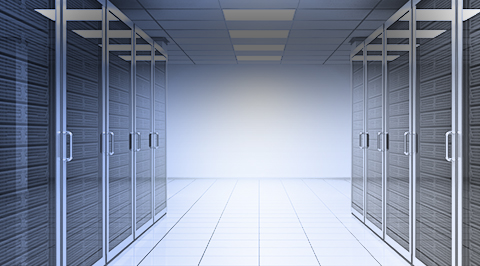
A long row of server racks in a darkened data center hall, cold aisles with blue LED lighting, precision cooling air conditioners mounted on the ceiling.
Data Center Engineering Infrastructure: From UPS to Cooling
Engineering infrastructure is what distinguishes a professional data center from a converted basement. Understanding how these systems work is critical when selecting a facility: this is where the main risks of failure are hidden.
Power Supply: From the City Grid to the Rack
The power path in a data center begins with two independent feeds from different city substations. This is the first line of defense: if one substation fails, the second automatically takes the load. Power then reaches distribution boards equipped with automatic transfer switch (ATS) systems.
The next critical element is the uninterruptible power supply (UPS). Modern UPS systems operate in online mode (double conversion): alternating current is converted into direct current and then back into alternating current. This completely isolates servers from voltage spikes, drops, and harmonic distortions in the city grid. Battery runtime is typically 15–30 minutes, which is enough time to start the diesel generator set.
The diesel generator set is the backup source that takes the load during a prolonged power outage. Professional data centers use an N+1 configuration: for every two operating generators, one additional generator is kept in reserve. Generator startup takes 30–60 seconds and occurs automatically when external power is lost. It is critical that the facility has enough fuel for at least 24–48 hours of continuous operation and that the fuel supplier contract provides priority delivery in emergency situations.
Cooling: Maintaining the Climate for Servers
Server equipment generates a significant amount of heat. A standard 10 kW rack requires approximately 10 kW of heat to be removed. Precision air conditioning systems (CRAC/CRAH) maintain temperatures in the range of 18–27°C and relative humidity of 40–60%.
Modern data centers use a hot-aisle/cold-aisle architecture: racks are installed in rows, with cold air supplied to the front of the servers and hot air removed from the rear. This improves cooling efficiency by 20–30% compared with traditional air-mixing configurations.
For high-density racks above 15–20 kW, additional solutions are used: liquid cooling, rear-door heat exchangers, or chillers with free cooling, which uses naturally cold outdoor air when temperatures are low. Growing demand for high-density computing power for AI is forcing data centers to reconsider their approaches to cooling and power supply.
Monitoring and Management of Engineering Systems
All engineering systems — power supply, cooling, ventilation, fire suppression — are connected to a building management system (BMS/DCIM). It monitors hundreds of parameters in real time: temperature at every point in the hall, humidity, UPS load, fuel levels, and diesel generator status. When parameters deviate from normal levels, the system automatically sends alerts to the engineering team on duty.
Attention. Saving money on redundancy is the most common mistake. An N+1 configuration — one backup component for every critical element — is not a luxury but a basic requirement for commercial use. Without it, a single air-conditioning unit failure in summer could shut down your entire server infrastructure. When selecting a data center, always request a single-line electrical diagram and cooling system diagram. A professional operator will provide them without objection.
Tier 3 and Tier 4 Reliability Levels: What Should You Choose?
Tier 3 and Tier 4 reliability levels are international standards developed by the Uptime Institute that describe the resilience of engineering systems. Tier 3 provides 99.982% uptime and allows scheduled maintenance without shutting down equipment through N+1 redundancy. Tier 4 raises the standard to 99.995% and provides complete redundancy of all power and cooling distribution paths, allowing the facility to withstand even a failure without shutting down servers.
What should a business choose? For most applications, Tier 3 is sufficient: it is a proven reliability level used by banks and telecom operators. Tier 4 is justified for financial institutions and critical government infrastructure, where even a minute of downtime can have serious consequences. The difference in construction and operating costs between these levels is significant, so paying extra for Tier 4 without a real business need is a common mistake.
Colocation Services: Rack Rental vs. Your Own Server Room
Colocation services mean renting space, power, and cooling in a data center for your own equipment. You purchase the servers, while the data center provides the rack, rack units, connectivity, and physical security. The alternative is to build your own server room or rent an entire hall, which requires capital investment and an engineering staff.
| Criterion | Colocation (Rack Rental) | Own Server Room |
|---|---|---|
| Capital costs | Low, pay as you use | High, construction and equipment |
| Resilience | Tier 3 / Tier 4 under SLA | Depends on budget and building |
| Scalability | Fast, add rack units | Limited by room capacity |
| Administration | Data center engineers + your remote access | Your own 24/7 staff |
| Redundant connectivity | Major carriers in the building | Must be connected separately |
For companies that do not want to maintain their own infrastructure, colocation in a data center provides Tier 3 reliability without capital investment in construction. You pay for the rental service rather than concrete and diesel generators.
Data Center Security: Physical Protection and Cybersecurity
Data center security is a multi-layered system that begins long before the server hall and extends far beyond the physical perimeter. For businesses storing critical data, understanding these layers is not a theoretical matter but a practical means of protection against real threats.
Physical Security: From the Perimeter to the Rack
The first level is the building perimeter. This includes fencing with access control, barriers, security patrols, and external video surveillance with analytics such as facial recognition and motion detection. The second level is the building itself: vestibules with biometric access control where one person cannot open the next door until the previous door has been closed (anti-passback).
The third level is the server halls. Access is restricted according to a role-based model: an engineer may enter only the areas required for their work. Every action is recorded in an event log: who entered or exited which zone and when. Video surveillance is conducted in high resolution, with recordings stored for at least 90 days.
The fourth level is the customer's rack itself. In a colocation model, the customer receives a physical key or access code only to their own rack or cabinet. Many operators also offer individual locks with electronic access logs.
Fire Suppression and Engineering Safety
The use of water-based fire suppression is prohibited in server halls because water can destroy equipment. Gas-based systems are used instead, including Novec 1230, FM-200, and inert gases, which do not damage electronics and are safe for people during short-term exposure. Detection systems use aspirating sensors that draw in air and analyze it for smoke particles. This makes it possible to detect a fire at the smoldering stage, long before open flames appear.
Water leak detection sensors are also installed around the perimeter of the halls and beneath raised floors. This is critical if the data center is located in a multi-story building or in a region at risk of flooding.
Cybersecurity: Protecting Data and Networks
Physical security is only half of the task. A data center must provide network segmentation: customer zones are isolated from one another and from the operator's management network. DDoS protection is implemented at the backbone level, with automatic traffic redirection through filtering centers.
Anomaly-monitoring systems analyze network traffic in real time, identifying suspicious patterns such as port scanning, unusual data transfer volumes, and unauthorized access attempts. Incidents are recorded and investigated according to established procedures, with customers notified within the timeframes specified in the SLA.
Compliance and Standards: What Should Actually Be Checked?
Compliance is important for customers handling sensitive data. Key standards for the Ukrainian market include:
-
ISO 27001 — an information security management system. Certification confirms that risk management and data protection processes are formalized and undergo regular audits.
-
PCI DSS — mandatory for companies processing payment cards. Requirements include physical server-room security, access control, and monitoring.
-
GDPR — if you work with data belonging to EU citizens, the data center must ensure compliance with personal data protection requirements.
Pro Tip. When selecting a data center, ask not only for certificates but also for the results of the latest security audits. A current report on actual inspections says more about process maturity than an outdated certificate displayed on a website. Also clarify how the operator responds to incidents: whether there is a customer notification procedure, who conducts investigations, and how evidence is preserved for law enforcement authorities.
A Unique Aspect: Remote Physical Security Control
Modern data centers offer customers tools for remotely monitoring the physical perimeter. For example, business security can include integration with Ajax security systems, allowing customers to monitor the physical perimeter remotely and receive real-time event notifications. This is especially valuable for companies with distributed infrastructure, where the owner cannot physically be present at the facility but wants complete transparency over access to their equipment.
Energy Efficiency and Sustainability: The PUE Metric
PUE (Power Usage Effectiveness) is the ratio of all energy consumed by a data center to the energy delivered directly to IT equipment. The ideal PUE is 1.0, while a good commercial figure is 1.2–1.4. The lower the PUE, the less energy is spent on cooling and losses, the lower the operating costs, and the lower the load on the power grid.
Energy consumption is becoming a critical issue: data center electricity consumption is projected to increase significantly through 2030. This creates pressure on local resources and can affect the development of new projects. For businesses, this means choosing a data center that is already investing in energy-efficient technologies; otherwise, you may face rising tariffs and regulatory restrictions.
How to Choose a Data Center: A Business Checklist
Choosing a data center comes down to checking four parameters: reliability, connectivity, security, and the operator's financial stability. Start with the Tier level and SLA: what uptime is guaranteed and what happens if the operator fails to meet it. Then check how many backbone providers are connected to the facility. The more independent connections there are, the greater the resilience.
-
Reliability level (Tier 3 or Tier 4) is documented
-
SLA includes guaranteed uptime and compensation for downtime
-
At least two independent backbone providers are available at the facility
-
Fire suppression and access-control systems comply with relevant standards
-
The operator is ready to provide PUE and energy-efficiency reports
-
24/7 remote monitoring and management are available
-
The operator's team answers technical questions without marketing language
Key Takeaway. The strongest data center agreement is one where the SLA is specified in hours and minutes rather than percentages of "desired" availability. Specific contractual terms protect you better than any verbal promises.
Common Mistakes When Choosing a Data Center and How to Avoid Them
The first mistake is choosing based on the lowest rack price. A cheap facility usually means weak redundancy, overloaded connections, and savings on security. The second is ignoring geography: if your users are in Europe while your servers are in Asia, latency can significantly reduce service quality. The third is having no migration plan, even though moving data and server capacity is a separate project that requires preparation.
Analysis of five data center construction cases shows that integrating infrastructure into the local environment is one of the most challenging tasks. The same applies when selecting a facility: check how the data center interacts with local power networks and regulators. Migration to the cloud or colocation should be carried out in stages, with every stage tested.
Choosing a data center is an investment in business continuity, and a mistake here can cost more than it appears during the initial cost-saving stage. COSMONOVA ensures uninterrupted server operation in secure data centers in Kyiv and Europe, provides reliable internet connectivity, and offers comprehensive solutions for television and video processing. Contact us for a consultation and get infrastructure that scales together with your business.