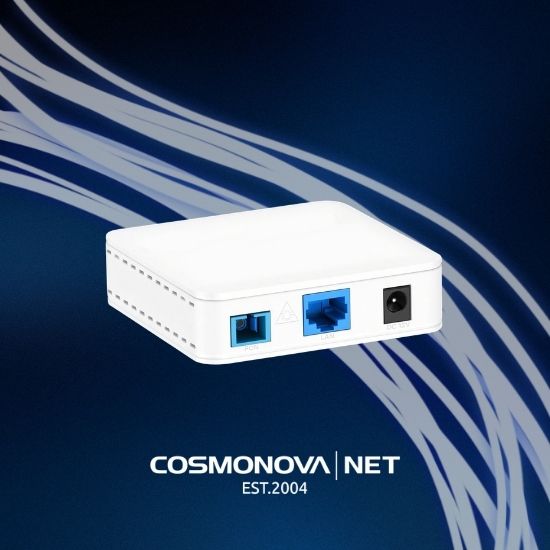
NG PON is a next-generation passive optical network technology that
provides high-speed data transmission over optical fiber without active
elements in the line. At COSMONOVA, we work with NG PON as one of the
key technologies for reliable internet access and scalable
communications infrastructure. NG PON evolved as a natural continuation
of GPON, offering significantly higher speeds and greater capacity.
PON technology has gone through several stages of evolution. According
to the IEEE NG-PON roadmap research, NG-PON1 represents an evolutionary
development of Gigabit PON, while NG-PON2 is a further step toward
increasing network capacity. The lifecycle of each PON generation is
typically 7--8 years, allowing operators to plan infrastructure
investments with future requirements in mind.
The GPON technology market was valued at USD 8.4 billion in 2026 and is
forecast to reach USD 12.8 billion by 2033, with projected annual growth
of 6.2%. This indicates stable demand for PON technologies and their
integration into global telecommunications infrastructure.
Comparing NG PON with GPON, EPON, and NG-PON2
The differences between these technologies lie in transmission speed,
architecture, and equipment compatibility. GPON (Gigabit PON) provides
asymmetric speeds of 2.5 Gbit/s downstream and 1.25 Gbit/s upstream,
suitable for most residential and small-business applications. EPON
(Ethernet PON) uses the IEEE 802.3ah standard and also operates at
gigabit speeds, but with a different architecture.
NG PON offers a significant performance leap. NG-PON2 supports 10/10
Gbit/s and 10/2.5 Gbit/s (downstream/upstream), which is four times the
capacity of GPON. The technology complies with ITU G.989.
Operators often consider XGS-PON as an intermediate stage before a full
transition to NG-PON2. The choice depends on the existing
infrastructure, modernization budget, and projected growth in bandwidth
demand.
Technology Downstream Upstream Standard Application
GPON 2.5 Gbit/s 1.25 Gbit/s ITU G.984.2 Residential and
small business
EPON 1 Gbit/s 1 Gbit/s IEEE 802.3ah Symmetric networks
NG PON 10 Gbit/s 2.5 Gbit/s ITU G.987 Growing operator
networks
NG PON G108 and G108N: Differences and Applications
The G108 and G108N models are customer optical network units (ONUs) that
convert an optical signal into an electrical signal for use by the
user's end device. G108 is a compact terminal supporting NG PON and
suitable for basic deployment scenarios. G108N is an extended version
with additional ports and support for more wavelength channels.
For residential users and small offices, G108 provides sufficient
functionality in a compact form factor. G108N is better suited to
corporate applications where higher bandwidth and more flexible port
configuration are required. Both devices are designed to work with OLT
(Optical Line Terminal) equipment on the provider's side.
Compatibility with provider equipment is critical. Before choosing a
device, make sure the terminal supports the wavelength channels and
standards used by your operator.
Pro Tip: When choosing between G108 and G108N, evaluate your current
and projected bandwidth requirements. A model with additional capacity
can help avoid costly upgrades in the coming years.
NG PON Stick SFP: A Compact Optical Transceiver
Close-up of an optical SFP transceiver inserted into a network
equipment port, showing its compact form factor and gold-plated
connectors.
NG PON SFP (Small Form-factor Pluggable) is a miniature optical
transceiver that connects directly to a network equipment port. The SFP
form factor allows multiple transceivers to be installed in one device,
providing efficient use of space and configuration flexibility.
The compact SFP-stick design provides an advantage during deployment.
Instead of replacing all equipment, a provider can install the required
SFP module into an existing port, reducing modernization costs and
deployment time.
Choosing the correct SFP module is critical. Make sure the transceiver
supports the required wavelength channels and is compatible with your
provider's OLT equipment.
ONU Compatibility with Provider Equipment
Compatibility between the ONU and provider equipment is a key factor in
successful deployment. The ONU must support the same standards and
wavelength channels as the OLT on the provider's side. If they do not
match, the equipment will not register on the network.
Four compatibility levels to check:
-
Technology and standard. GPON (ITU G.984), XGS-PON (ITU
G.9807.1), and NG-PON2 (ITU G.989) are different protocol sets. -
Wavelengths and line budget. Typical GPON wavelengths are 1490
nm downstream and 1310 nm upstream; for XGS-PON, 1577 nm downstream
and 1270 nm upstream. -
Optical budget. B+, C+, and C++ classes are designed for
different levels of line attenuation. -
Registration logic. Operators use a serial number (SN),
registration password (PLOAM/registration ID), or a combination of
SN + password.
How to check compatibility before purchase:
-
Ask the provider for the exact OLT model and supported PON
standards. -
Check whether ONU certification is required and whether there is a
list of approved models. -
Find out the registration format and how it is entered.
-
Check the power class and optical-budget margin.
-
Match power and port requirements (LAN, VoIP, Wi-Fi) to your use
case.
Attention: Using uncertified equipment may result in service denial
or the provider blocking the connection.
Registration and initial setup:
-
Connect the ONU to the optical port and supply power.
-
Wait for the registration status.
-
In the terminal's web interface, enter the serial number or
registration password if required. -
Configure the VLAN ID and port mode according to the operator's
requirements. -
Check the received signal level.
Troubleshooting common issues:
-
PON indicator is off. Check the optical patch cord, connectors,
and signal level. -
Terminal does not register. Verify the SN/password and PON
standard. -
Connection is available but there is no internet. Check the VLAN
ID and routing settings. -
Speed is lower than expected. Check line attenuation and OLT
port utilization.
Pro Tip: Save the terminal's serial number and registration password
immediately after purchase.
Specifications and Data Transmission Speed
Data transmission speed is one of the key NG PON parameters. Actual
capacity depends on the distance from the OLT to the ONU, optical cable
and connection quality, and the load on the optical line.
10G PON has gradually become a leading deployment technology due to its
developed supply chain and strong performance. NG PON supports multiple
wavelength channels, allowing capacity to be increased without replacing
the physical infrastructure.
How to Choose NG PON for Your Network
Choosing NG PON requires an analysis of current and future needs,
including the number of users, applications, and traffic volume.
Three scenarios:
-
Home internet and small office. A compact terminal with one
optical port and Wi-Fi is sufficient. G108 is suitable. -
Replacing an existing terminal. The key criterion is
compatibility with the operator's OLT and the registration method. -
Installation in an SFP slot. The SFP stick connects directly to
a router or switch and does not require a separate power adapter.
Parameter G108 G108N SFP stick
Form factor Compact terminal Extended terminal SFP module
Ports Basic set More ports None
Power Separate adapter Separate adapter From device slot
Purpose Home, small Corporate tasks Terminal
office replacement,
space saving
NG PON selection criteria:
-
Required data transmission speed
-
Number of subscribers and projected growth
-
Compatibility with existing equipment
-
Form factor
-
Equipment availability and cost
-
Provider support and certification
-
Network development plans for the next 5--10 years
Actual capacity and network limitations. Line speed and subscriber
speed are not the same thing. Final capacity is affected by optical-line
attenuation, splitter ratio, OLT port utilization during peak hours, and
terminal performance.
Key takeaway: Choosing NG PON is an investment in the future of your
network. Select a technology and form factor that will provide
sufficient capacity for the next 5--7 years.
At COSMONOVA, we help operators and organizations assess bandwidth
requirements and choose the optimal solution for their infrastructure.
Frequently Asked Questions
What does NG PON mean and how is it different from GPON?
NG PON (Next-Generation PON) is the next generation of passive optical
networks, providing higher capacity than GPON. While GPON supports
speeds of up to 2.5 Gbit/s in one direction, NG PON reaches 10 Gbit/s
and higher.
How do I choose between NG PON G108 and G108N?
G108 and G108N are ONU terminal models for NG PON with different
specifications. G108 is suitable for basic scenarios, while G108N is
intended for higher-performance applications. The choice depends on
speed, number of ports, and compatibility with provider equipment.
Is an NG PON ONU terminal compatible with equipment from any provider?
Compatibility depends on the standards supported by both the terminal
and the provider's OLT. Before purchasing, ask the provider for a list
of compatible equipment and registration requirements.
What is the advantage of an NG PON Stick SFP over standalone terminals?
NG PON Stick SFP is a compact optical transceiver that connects directly
to network equipment ports. Its main advantages are flexibility and
space savings.